
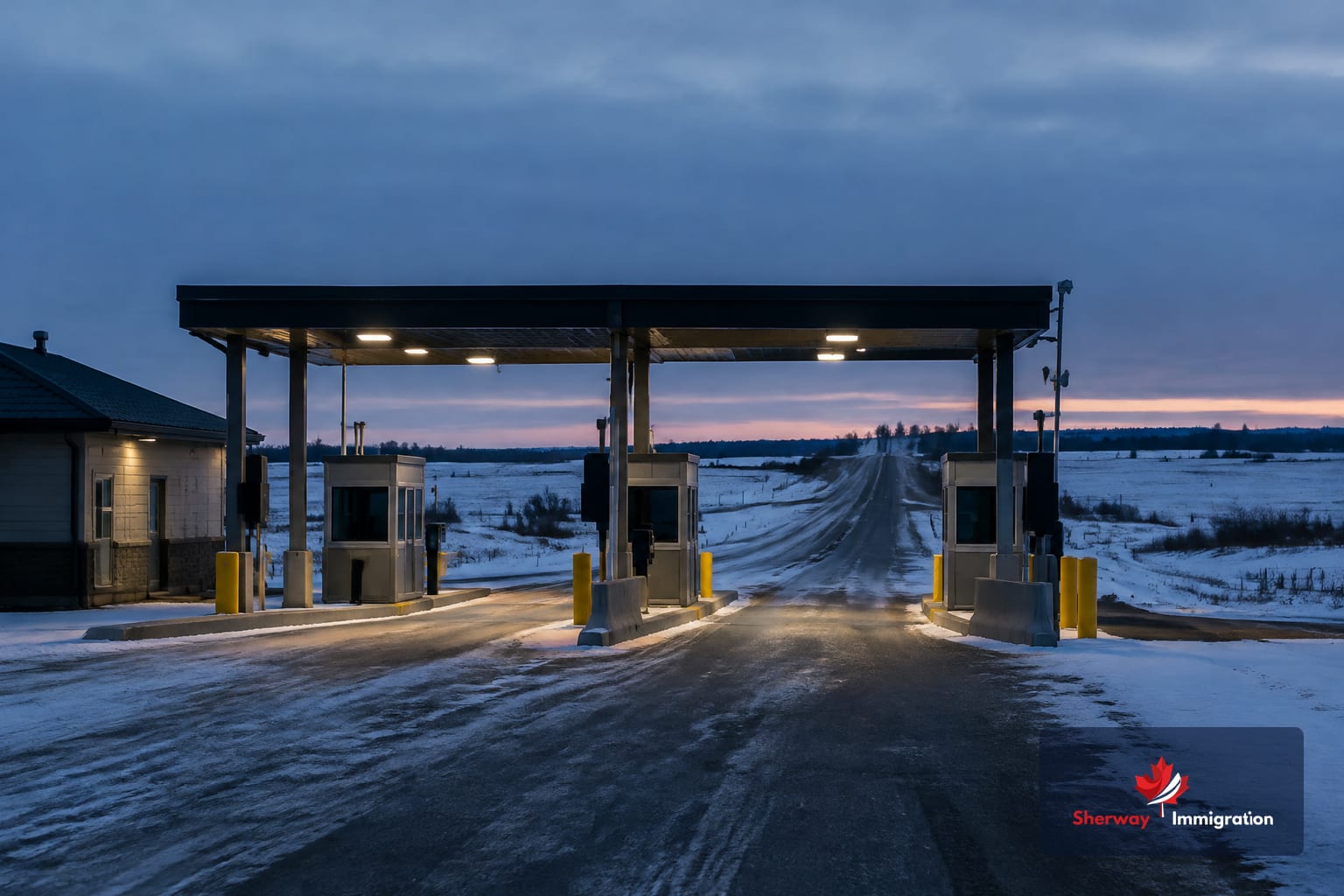
If your plans include driving into Canada through a smaller Prairie or British Columbia land crossing this winter, the hours you're used to may not be the hours in effect. From November 1, 2026 to March 14, 2027, CBSA is operating shortened winter service windows at 26 land ports of entry, and several of those ports close to commercial traffic on weekends and holidays entirely. The reason is a clock mismatch: Alberta, B.C. and Manitoba now sit on permanent daylight saving time while the neighbouring U.S. states still change their clocks twice a year, so the two sides of the same border stop lining up for roughly four and a half months.
This is a scheduling story, not a policy story. No eligibility rule changed, no program was amended. But a closed booth at 7 p.m. is just as much of a problem as a refused application if you're sitting on the American side with a vehicle full of belongings and a deadline.
Why the clocks are the reason
Border crossings don't operate in isolation. A land port of entry is two facilities facing each other, and when one side is staffed and the other isn't, the crossing effectively doesn't function. For most of the year the Canadian and American clocks on the Prairie and B.C. borders move together, so posted hours on each side stay in sync without anyone thinking about it.
That stops working when one jurisdiction stops shifting its clocks. As described in CBSA's port of entry directory and hours listing, the permanent daylight saving time arrangement in Alberta, B.C. and Manitoba now puts those provinces an hour out of step with the adjacent U.S. states during the winter months. CBSA's response is to compress the service window at the affected small ports for the duration — November 1 through March 14 — rather than staff hours when the other side of the line is dark.
It's a practical fix. It's also the kind of operational detail that never makes it into anyone's travel checklist until it causes a problem.
What's actually changing
Twenty-six land crossings across the three provinces move to shortened winter hours for the period. Two specifics are worth sitting with:
The daily window is narrower. A port that normally accepts travellers into the evening may close earlier, and the published Canadian hours are what govern your arrival. Showing up fifteen minutes after closing is the same as showing up on a day the port is shut.
Commercial traffic is treated separately. Several of these ports close to commercial traffic on weekends and holidays outright during the winter period. For a carrier, an owner-operator, or anyone moving goods on a schedule, that's not a minor inconvenience it can mean rerouting to a larger 24-hour crossing hours out of the way, or rescheduling the trip.
CBSA publishes current hours by province through the directory linked above. Because the hours are seasonal and specific to each port, the only reliable answer for any given crossing is the one on that page on the day you check it.
Who this actually affects
Anyone whose entry to Canada happens on a road rather than at an airport, during this window, at one of the smaller ports.
That covers more immigration relevant situations than people expect. Permanent residents driving back from a trip south. Work permit or study permit holders returning to Canada after a visit home or a weekend across the line. Visitors arriving by car. Families splitting a long drive across two days and counting on a particular crossing being open when they reach it. Commercial drivers whose work authorization is tied to cross-border trucking.
If you're arriving at a port of entry expecting to deal with a document matter at the border rather than simply re-entering anything that needs an officer's time and attention rather than a wave through a compressed service window matters even more, because there's less room in the day to absorb a long secondary review. Some temporary residence categories are closely tied to port of entry processing; if that's the route you're considering, it's worth reading through the [LMIA-exempt work permit categories and what each one requires](/canada/lmia exempt work permits) before you plan a drive around it, and getting the timing confirmed rather than assumed.
There's also a quieter group affected here: people in remote border communities where the nearest alternative crossing is a long detour. For them a two-hour reduction in daily hours isn't a scheduling note, it's the difference between a same-day trip and an overnight.
What to map out before November 1
A few things are worth doing while there's still time to adjust.
- Identify the exact port you intend to use by name, not by highway or by "the one near town." Hours are published per port and neighbouring crossings can differ considerably.
- Check the hours for both the Canadian and the U.S. side. Your trip needs both to be open, and during the mismatch period they may not overlap the way they did in October.
- If you're moving commercial goods, confirm weekend and holiday commercial service specifically. Passenger hours and commercial hours are not the same thing at these ports, and the weekend closures are the detail most likely to catch someone out.
- Build a buffer. Winter road conditions in the Prairies and interior B.C. already make arrival times unpredictable; a shorter service window removes the slack you'd normally have.
- Have a fallback crossing picked out before you leave, with its hours checked too. Finding one on a phone with poor reception at 9 p.m. in February is not the plan you want.
And re check closer to the date. Published hours can be adjusted, and the version you read in October isn't necessarily the version in force in January.
Questions this tends to raise
Does this change anything about who can enter Canada? Nothing in this notice speaks to admissibility, status, or program requirements. It addresses when specific ports are staffed. Entry decisions remain with the officer at the port, on the same grounds as before.
Will my permit or status be affected if I can't cross on the day I planned? The hours themselves don't alter any document's validity. But timing pressure is real for people with dated obligations a permit expiry, a start date with an employer, a residency calculation. Those are situation-specific, and whether a delayed crossing creates a problem depends on facts a general article can't settle.
Is March 14, 2027 the end of it? That's the end date given for this winter period. The underlying mismatch permanent daylight saving time on one side, seasonal clock changes on the other doesn't go away, so it's reasonable to expect the question to come back next autumn unless something changes on the American side.
What to watch next
Two things. First, whether the list of 26 ports stays stable through the period or gets adjusted CBSA updates its published hours, and the directory is the place that reflects it. Second, whether this becomes an annual pattern. A permanent time arrangement in three provinces against a seasonal one across the line is a structural mismatch, not a one-off, and that suggests travellers crossing at smaller Prairie and B.C. ports should get used to checking winter hours the way they check winter road reports.
For most people, this is a half-hour of planning that prevents a wasted day. For commercial operators and for anyone whose crossing is tied to a document deadline, it deserves more thought than that.
If your travel plans intersect with a pending application, a permit expiry, or a residency obligation and you're not sure whether a border delay creates exposure, an RCIC can assess your specific case. You're welcome to book a consultation and get a professional read before you commit to a route.